
Published October 7, 2022
If Only Bricks Could Talk...

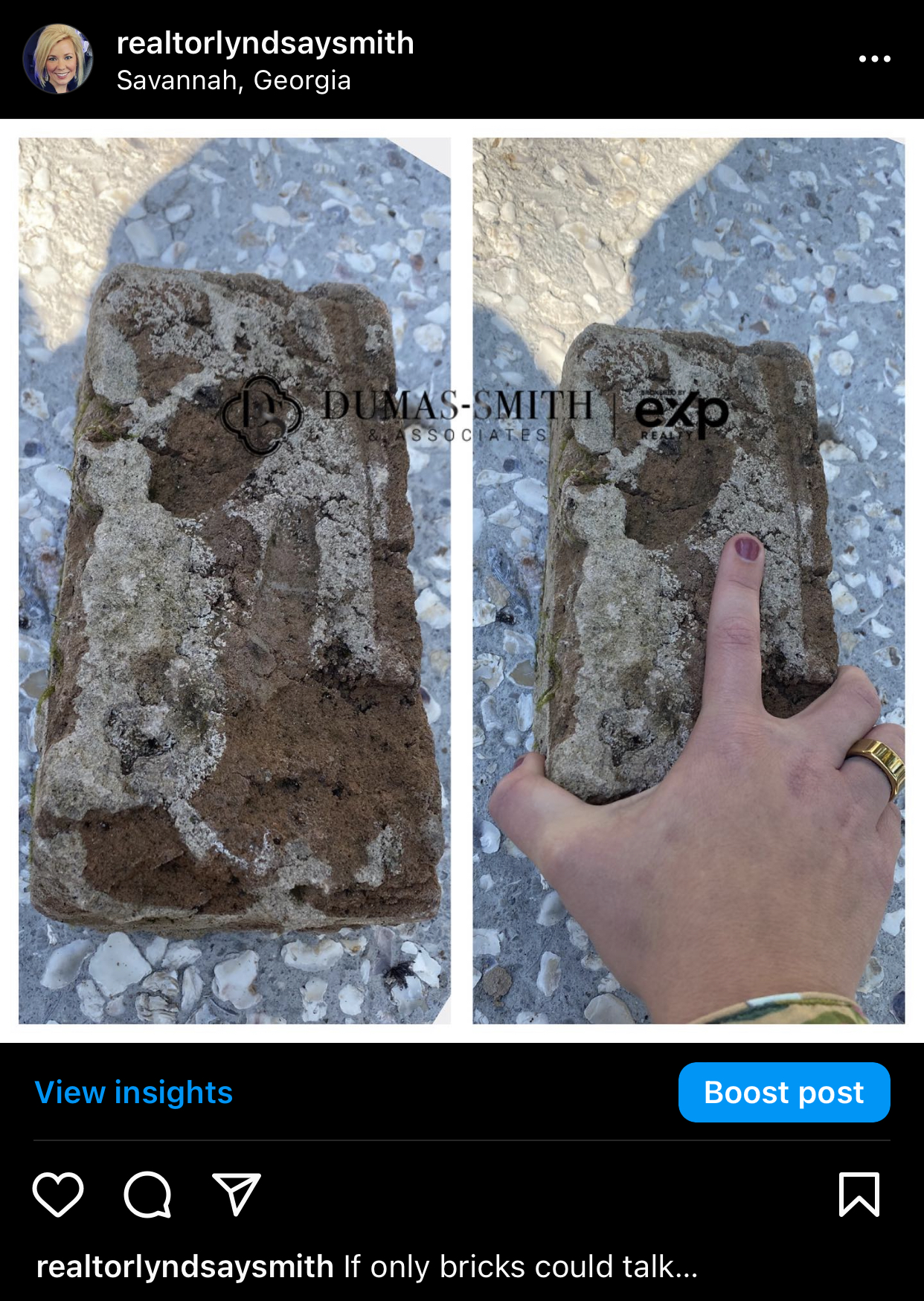
Unlike many other parts of the country, Savannah has no natural stones that are extracted from the ground locally. Not even the “cobblestones” that line Savannah’s River Street are natural to Savannah’s geology. These stones were originally “ballast material,” which means they were used to stabilize ships and came from all different areas.
Old Savannah Gray bricks are about as close as you will get to having a “natural stone” as an element of construction that is formed from Savannah’s local elements. These bricks are as much a part of the history and tell the story of early Savannah as the cobblestones and ornamental iron that lines the beautiful oak shaded streets of this historic hostess city.
Old Savannah Gray bricks date back to the early 1800s. They were hand-formed by slaves at the Hermitage Plantation. The Plantation sat on the Savannah River where International Paper currently stands. The Hermitage Plantation was originally a cotton plantation (and is thought to be where Eli Whitney made his cotton gin breakthrough). Eventually, the Hermitage Plantation became more well-known for their unique, oversized bricks. Where the plantation was located, the banks of the Savannah river had a rare type of gray-colored clay (aka, “marsh mud” in the south). Because the mud was gray, the brick earned the name, “Savannah Gray Brick.” Once baked, it became red. It was the cheap brick that re-built Savannah after a massive fire in 1820 destroyed many sections of the city.
The bricks were no longer made after the Civil War, and today they prove to be very valuable and coveted. Many bricks were lost before the formation of the Historic Savannah Foundation in the mid-1950’s. Prior to the formation of this society, buildings were often demolished with no thought to preservation. Today, examples of the surviving brick can be found in Savannah's Historic District and beyond, even Fort Pulaski dawns the Old Savannah Gray Brick.

Photo credit: Denise Gonsales Photography - Photo taken at Fort Pulaski of our very own, Lauren Hollar and her husband, Aaron. Lauren is our Transaction Coordinator.
The old First African Baptist Church was rebuilt in 1855, using Savannah Grays made by congregation members who worked at the Hermitage.
Henry Ford, Founder of Ford Motor Company, bought the Hermitage plantation. He later salvaged and used the Old Savannah Gray bricks from the plantation to build his mansion on the banks of the Ogeechee River in what would become known as “The Ford Plantation,” one of our area's most prestigious communities.

Photo: https://fordfieldandriverclub.com/lifestyle/main-house/
While the cost of Savannah Grays makes them prohibitive for most people to use them on the construction of the entire exterior of a home, the bricks are highly sought after by homeowners and builders who want to use them for interior accent walls or smaller outdoor projects, such as patios or fireplaces.
No two Savannah Gray bricks will be exactly alike, the bricks feel a bit heavier than a typical brick and one of the most distinctive and fascinating features of the bricks is that if you look closely, you can find fingerprints (and sometimes hand prints) in the brick. When the bricks were produced mud was dug out of the marsh, mixed with straw, put into wood-framed moulds and left to set. Once the bricks were dry, they were then fired in a kiln to solidify and strengthen.

Click here to like and follow our posts to see more like this!
Holding them in your hand is like holding a little piece of history. Think about where our city/country was in the history of time during the 1800s and the progress it has made. Sadly, the names of the enslaved people who made these ornamental bricks that “rebuilt this city” have likely been lost, but these bricks are still telling their story, generation after generation. When I look at these bricks and see the fingerprints or the handprints that have been left behind, it’s a reminder that these bricks tell a story, a story of progression. The architecture of our city is beautiful and the history is interesting, but don't look past the handprint or the fingerprint that makes up that part of history. That print has its own story to tell. If only bricks could talk…
Thank you, Page Aiken, for generously allowing me to utilize the research about the history of the Old Savannah Gray Brick that you did. Page Aikens specializes in Coastal Georgia luxury homes with a focus on St. Simons and Sea Island and the spectacular lifestyle that both have to offer. His proprietary database of historic island cottages and his knowledge of luxury island homes distinguishes him as he leverages local knowledge with over 30 years of real estate experience. He loves working with either buyers or sellers, always working hard to ensure the best outcome for every client he represents. Page grew up living on Sea Island and St. Simons and is a seventh-generation native. He earned his degree in International Business from the Terry School of Business at the University of Georgia and has extensive international real estate experience - ideal for utilizing today's regional and worldwide marketing platform.

Lyndsay Smith
Owner | Realtor® | Dumas-Smith & Associates Realty Group | KW
or another way